
How to read a dog food label
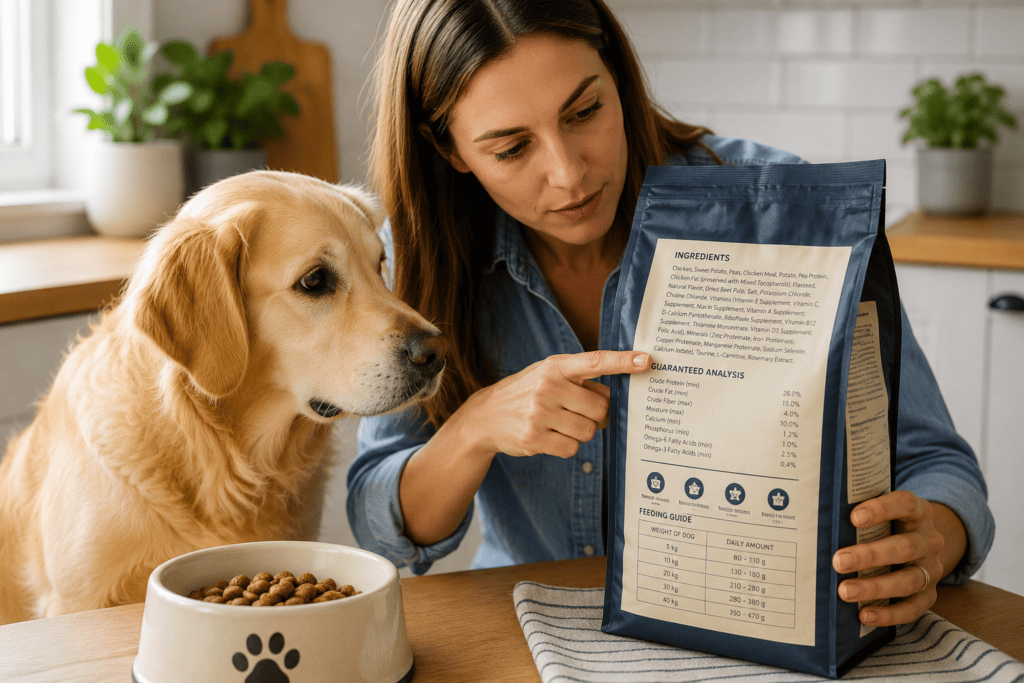
Dog food labels are written to be glanced at, not read. The front of the bag is a mood board - grateful dogs, farm scenery, words like “natural” and “wholesome” that carry no legal weight. The back of the bag is a legal document. Everything true lives on the back, usually in a font size chosen by someone who hopes you will not bother.
The good news: there are only five tricks, and once you know them you cannot unsee them. This is the by-hand version of what our open rating algorithm does to every one of the 3,075 foods we have scored - and every ingredient mentioned below links to its page in our ingredients A-Z, where we currently explain 464 of them.
Trick 1: “meat and animal derivatives” - the composite category
The heavyweight champion of label vagueness. UK pet food may declare ingredients either by name or by legal category - and a category can swallow almost anything[1]. The four you will meet most often:Meat and animal derivativesThe vaguest term on any UK label - it can mean almost any animal part from almost any species, and the recipe can change batch to batch.Fish and fish derivativesFish of some sort, parts unspecified.Cereals (unspecified)Which cereals?Derivatives of vegetable originA catch-all for plant by-products - could be decent fibre, could be floor sweepings from milling.
The problem is not that derivatives are poison - organ meat is nutritious, and plenty ends up in respectable foods. The problem is that a category is a blank cheque: the contents can change batch to batch with commodity prices, so the food your dog thrived on in March may be a different recipe in May, behind an identical label.
For a dog with a suspected trigger it is disqualifying - you cannot avoid an ingredient the label will not name, which is why our hypoallergenic guide treats composite categories as an automatic fail.
Trick 2: what “with chicken” really means - the 4% game
The front of the pack says CHICKEN in letters visible from space. The recipe disagrees. Under the labelling code, the wording tells you the minimum the food must contain[1]:
- “Chicken flavour” - barely any chicken required at all
- “With chicken” - about 4% chicken
- “Rich in chicken” - about 14%
- “Chicken dinner” or “chicken menu” - about 26%
So a tray called “with chicken” can be 4% chicken and 96% something else - perfectly legal, provided the numbers are on the back. The photography does the lying; the label technically tells the truth. Wet food leans on this trick hardest, which is why our wet food guide has its own section on it.
Trick 3: ingredient splitting - one grain, three names
Ingredients are listed by weight, heaviest first - so the first ingredient is the recipe’s headline. Unless the recipe splits one ingredient into several smaller entries, each listed separately, each conveniently lighter than the meat.MaizeMaize is not the villain some sites make out, but it is not doing your dog favours either - a cheap energy source that lets a recipe hit its numbers inexpensively.Maize gluten mealThe protein fraction of maize - a cheap way to raise the protein figure without meat.Maize flourMilled maize - cheap carbohydrate in powder form.
Add those three together and maize may comfortably outweigh the chicken sitting proudly at the top of the list. Same grain, three names, one impression neatly managed. When you see cousins of the same ingredient scattered down a label, add them up before deciding what the food is really made of.
Trick 4: “fresh meat first” - the water trick
“Fresh chicken first ingredient” sounds like a promise. Remember that ingredients are weighed at the point of processing - and fresh meat is roughly two-thirds water. Cook the food, and most of that weight evaporates out of the finished kibble.ChickenNamed fresh chicken - digestible, lean and exactly what a label should say.Chicken mealChicken with the water removed before weighing - so gram for gram it carries more protein than fresh chicken.
Chicken meal - meat already rendered and dried - is about a third of the weight for the same nutritional payload, so it sits lower on a label even when it contributes more actual chicken. Neither is a villain: fresh meat is a fine ingredient, and a good meal is honest, concentrated nutrition. The trick is using fresh meat’s water weight to claim first place, then quietly building the food on grain. The tell is the declared meat percentage: if “fresh chicken first” comes with a single-digit percentage, the top spot is theatre.
Trick 5: padding and cosmetics at the bottom of the list
The back half of an ingredient list is where recipes whisper. Read it the way you would read the last paragraph of a contract - quickly is exactly what they are hoping for. Three things worth catching:Oils and fats (unspecified)Unnamed oils and fats of unknown origin and quality.Digest (unspecified)A flavour coating made from hydrolysed animal tissue - which animal, the label does not say.Artificial coloursDye for the human buying the food - your dog cannot see the pretty colours and did not ask for the additives behind them.SugarAdded sugar in dog food serves the manufacturer's palatability tests, not your dog's teeth or waistline.
Unspecified “oils and fats” is the category trick again - it can mean salmon oil or recycled frying fat, and the label is not telling. “Digest” is flavour coating sprayed onto kibble to make refusal-grade ingredients interesting. Colours exist because kibble is naturally brown and buyers are not - your dog would happily eat it grey. And added sugars serve the same audience as the colours: a dog’s dinner does not need caramelising.
None of these will hurt a healthy dog in the doses involved. What they tell you is who the recipe was written for - and it was not the one eating it.
The word that matters more than any ingredient: “complete”
Before any of the tricks, find one word on the pack: “complete”. A complete food is legally required to deliver every nutrient a dog needs; a “complementary” food is a topper, a treat or a mixer, and feeding it as dinner will slowly leave gaps in the diet. Brands do not hide this word, exactly - but they print it quietly, and a beautiful tray of “complementary” chunks in gravy looks an awful lot like dinner.
Rule of thumb: if the pack does not say “complete”, it is a snack wearing a dinner’s photography.
The analysis panel: what the analytical constituents actually tell you
The second half of the label is the small table headed “analytical constituents” - protein, fat, fibre, ash, sometimes moisture. This is the most honest part of any label, because the numbers are measured, not written by marketing. Three things worth knowing:
- Protein and fat are the headline. For a typical adult kibble, mid-20s% protein and low-to-mid teens% fat is ordinary; well above or below deserves a reason (working dog, weight control, growth).
- “Ash” is not burnt filler. It is the measured mineral content - what would remain if the food were incinerated in a lab. Every food has it; moderate ash mostly reflects bone and mineral content, and only extremes are worth a raised eyebrow.
- Never compare wet and dry numbers directly. A wet food declaring 8% protein can carry MORE protein than a kibble declaring 24%, because the wet food is three-quarters water. Strip the moisture out (the dry-matter comparison) before judging - it is the single most common way owners misread labels, and our wet vs dry guide shows the maths.
Our score does the dry-matter conversion automatically on every food page, so the protein you see is always comparable.
The 60-second label check
In the shop, phone in one hand, bag in the other:
- 1. Find “complete”: if the pack says “complementary”, it is a topper, not dinner - stop here.
- 2. First ingredient: a named meat with a percentage? Good start. A category or a grain? Note it.
- 3. Scan for categories: “derivatives”, “cereals”, unspecified “oils and fats” - each one is a question the label refuses to answer.
- 4. Add up the splits: same ingredient under several names? Total it mentally and re-rank the list.
- 5. Check the meat percentage: the declared figure beats the ingredient order every time.
- 6. Sweep the tail: colours, sugars, unnamed digests - cosmetics your dog never asked for.
- 7. Or skip the lot: look the food up in our directory - the score has already done this, ingredient by ingredient, and shows its working.
A worked example
Here is a composite label - not one product, but a pattern you will find on plenty of budget bags, assembled from the tricks above:
“Cereals (min 4% wheat), meat and animal derivatives (min 4% chicken), derivatives of vegetable origin, oils and fats, various sugars, minerals. With colourants and antioxidants.”
The label, translated line by line
Translated line by line:
- “Cereals (min 4% wheat)” - the main ingredient is unnamed grain. Only the 4% supporting the front-of-pack claim is identified; the rest is whatever milled cheapest this quarter.
- “Meat and animal derivatives (min 4% chicken)” - the meat is a category. The 4% chicken exists so the bag may say “with chicken”; the remaining animal content is anonymous.
- “Derivatives of vegetable origin” - plant matter, identity withheld.
- “Oils and fats” - source unknown, quality unknowable.
- “Various sugars” - sweetening, for no canine reason.
- “With colourants” - the food is being dressed for you.
Now the same information as a clear label writes it: “Chicken meal (26%), brown rice (23%), oats, beet pulp, chicken fat, salmon oil, minerals” - every ingredient named, the meat quantified, nothing hiding. Both bags sit on the same shelf; only one of them will tell you what is inside it.
What our score does with all this
Everything on this page is mechanical - which is exactly why we automated it. Our open algorithm reads every label the way this guide just did: it rewards named ingredients and declared percentages, penalises categories, splitting and cosmetics, and shows its working on every food page, point by point. No “trust us” - the entire formula is public.
What does meat and animal derivatives mean in dog food?
It is a legal category, not an ingredient: any warm-blooded land animal, any edible part, in any proportion - and the mix can change from batch to batch depending on market prices. It is not automatically dangerous, but it makes the recipe unknowable, which is why our score penalises it.
What does with chicken mean on a dog food label?
Under pet food labelling rules, with chicken needs only about 4 percent chicken. Rich in chicken means around 14 percent, chicken dinner or menu around 26 percent, and chicken flavour may contain barely any chicken at all. The picture on the front is decoration; the percentage on the back is the fact.
Are dog food ingredients listed in order?
Yes - by weight at the point of processing, heaviest first. The catch is that fresh meat is weighed with all its water, which pushes it up the list; after cooking, a bag led by fresh chicken may actually contain more grain than meat. Compare the meat percentage, not the position, and watch for one grain split into several entries.
Which dog food ingredients should I avoid?
The pattern to avoid is vagueness: unnamed derivative categories, unspecified oils and fats, and unnamed digests, plus artificial colours and added sugars, which serve the buyer rather than the dog. Our ingredients A-Z rates every ingredient we track as green, amber or red with an explanation for each.
Sources
This is label analysis, not veterinary advice - if your dog has a health condition, talk to your vet before switching foods.