
Is raw feeding safe? What the evidence actually says
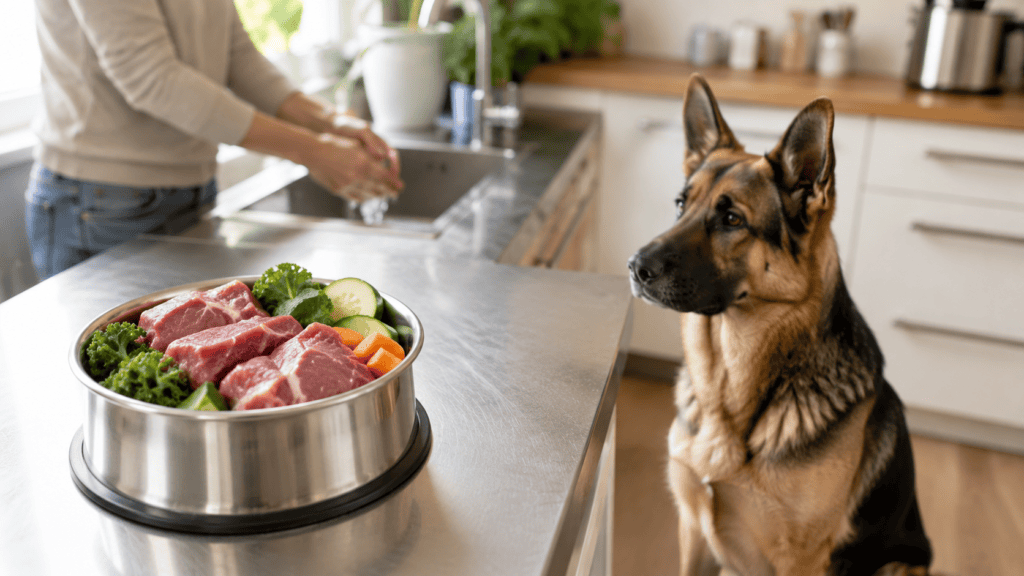
Raw food scores better than any other format we rate. Not marginally - nearly nine in ten raw foods clear 80, against roughly one in five dry foods, with a median score of 88 (checked August 2026). If our scoring is any good, that is a striking result, and it deserves both an explanation and a serious look at what raw feeding actually costs you.
Why raw scores so well
There is no mystery to it. Our open score rewards named ingredients, declared percentages, short lists and the absence of vague categories - and raw labels are unusually plain. A typical raw recipe is a handful of named animal parts and some vegetables.
The numbers, across the raw foods we rate (checked August 2026):
- 87% score 80 or above - against 22% of dry foods
- Median score 88, against 70 for dry
- Median declared meat content 63%, against 26% for dry
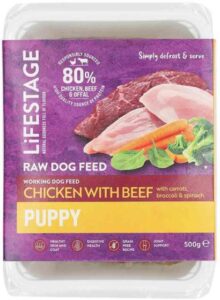
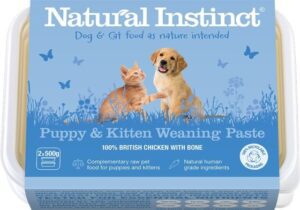
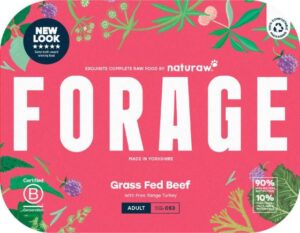
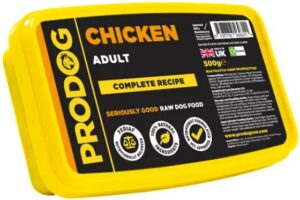
That last figure is doing most of the work. Raw food is mostly meat, and it says so on the label with a number attached. Here is the current top of the raw table - live, so it re-ranks itself as we rate more:
The risks, stated properly
Bacteria - and this one is about you too
Raw meat carries Salmonella, Campylobacter, Listeria and E. coli. Dogs tolerate a bacterial load that would flatten a person reasonably well, though they can still become ill and can shed pathogens in their stool while showing no symptoms at all.
This is not a vague worry, and we would rather give you the actual numbers than a warning. An FDA survey of 1,056 pet food samples found around 8 per cent of raw products positive for Salmonella and 16 per cent for Listeria monocytogenes. [1] A Dutch study of 35 frozen raw products from eight brands found Salmonella in 20 per cent and Listeria monocytogenes in 54 per cent. [2]
Now the number that actually matters. In that same FDA survey, 480 dry and semi-moist samples produced two positives between them. So this is not a “pet food is filthy” story - the cooked formats come back essentially clean, because heat kills these organisms. It is specific to the formats that never get heated. That is precisely why our processing score puts gently cooked food above raw rather than below it: minimal processing is a genuine virtue, but “minimally processed” and “no kill step” are the same sentence.
The under-discussed part is human exposure. The bowl, the fridge shelf, the worktop, the dog’s face and the dog’s stool all become potential routes. Public-health bodies advise particular caution in households with infants, elderly or immunocompromised people. [3]
This is manageable with ordinary food-hygiene discipline - dedicated bowls and boards, thorough handwashing, thawing in the fridge rather than on the side, prompt cleaning. It is not manageable by ignoring it.
Bones
Raw bones are considerably safer than cooked bones, which splinter and should never be given to a dog under any circumstances. But raw bones still cause fractured teeth, choking and intestinal obstruction. Dense weight-bearing bones from large animals are the worst offenders for teeth.
Many complete raw products use finely ground bone, which sidesteps the issue entirely while keeping the calcium. If you feed whole bones, supervise, and match the bone to the dog.
Nutritional balance
A commercially prepared complete raw food is formulated to be nutritionally complete. A home-made bowl of meat is not, and the deficiencies build slowly enough that they are hard to spot until they matter - calcium and phosphorus balance especially.
If you want to feed raw without a nutrition qualification, buy complete. It is the single easiest risk to eliminate.
The cost, which nobody leads with
Raw medians around £2.83 a day against £0.89 for dry (checked August 2026). Roughly three times as much, every day, plus freezer space and preparation time.
Over a twelve-year life that is a difference of several thousand pounds. It may well be worth it to you - but it should be a decision you made rather than one you drifted into. Our cost guide puts every format side by side.
Worth knowing: over 150 foods in our catalogue score 80 or above at under £1 a day. You do not have to feed raw to feed well.
If you are going to do it, do it properly
- Buy complete, at least at first. “Complete” on the label means formulated as a whole diet. DIY is where imbalance creeps in.
- Dedicate the equipment. Separate bowl, board and utensils, washed at high temperature.
- Thaw in the fridge, never on the worktop, and use within a couple of days.
- Transition slowly. Raw is a big change; our switching guide has the ratios.
- Watch the stools. Raw-fed stools are typically smaller and firmer. Persistently loose, or any blood, means stop and call the vet.
What a good raw food looks like on the label
The same rules apply as anywhere else, and raw makes them easy to check. You want named species with percentages - not a category. These are the terms that cost points wherever they appear:Meat and animal derivativesThe vaguest term on any UK label - it can mean almost any animal part from almost any species, and the recipe can change batch to batch.Oils and fats (unspecified)Unnamed oils and fats of unknown origin and quality.
A raw food listing “meat and animal derivatives” is telling you as little as a budget kibble does. Most do far better than that, which is exactly why the category scores as it does. Our label guide covers the full vocabulary.
The honest summary
Raw feeding gives you the clearest ingredient lists in the catalogue and the highest scores we award. It also asks for more money, more freezer space, more handling discipline, and a genuine hygiene commitment if there are vulnerable people in the house.
It is a legitimate way to feed a dog well. So is a high-scoring kibble at a third of the price. Anyone telling you there is only one right answer is selling something.
Where to go next
- The best raw dog food - top 10, ranked
- Browse every raw food we rate and filter by protein or price
- What feeding a dog actually costs, format by format
Is raw dog food safe?
For a healthy dog in a household that handles it properly, raw feeding is widely practised without incident. The genuine risks are bacterial contamination, bones causing damage or obstruction, and nutritional imbalance in home-made recipes. The contamination risk is measured rather than theoretical: surveys find Salmonella in roughly 8 to 20 percent of raw products and Listeria monocytogenes in 16 to 54 percent, and it threatens the humans in the house as much as the dog. All of it is manageable with ordinary food-hygiene discipline, and none of it is manageable by ignoring it.
Why does raw dog food score so highly on OnlyDogFood?
Because our score reads labels, and raw labels are unusually clear: nearly nine in ten raw foods reach 80 or above against roughly one in five dry foods, with a typical declared meat content around two thirds of the recipe. Raw recipes are typically short, named and meat-dominant, which is exactly what the scoring rewards.
Can I feed raw to a puppy?
Yes, but only a complete, properly balanced raw diet formulated for growth - not meat and bone alone. Calcium and phosphorus balance matters enormously in a growing skeleton, and getting it wrong causes permanent damage. Large-breed puppies especially warrant a vet conversation first.
Are raw bones safe for dogs?
Raw bones are far safer than cooked ones, which splinter and should never be given. But raw bones still carry real risks: fractured teeth, choking and internal obstruction. Weight-bearing bones from large animals are the most likely to break teeth. Never leave a dog unsupervised with a bone.
Is raw food more expensive than kibble?
Considerably. Raw typically costs around three times as much per day as dry food, plus freezer space and handling time. That is the honest trade-off against its scoring advantage.
Sources
- Nemser et al., Foodborne Pathogens and Disease, 2014 - Investigation of Listeria, Salmonella, and toxigenic Escherichia coli in various pet foods
- van Bree et al., Veterinary Record, 2018 - Zoonotic bacteria and parasites found in raw meat-based diets for cats and dogs
- FDA - Get the facts: raw pet food diets can be dangerous to you and your pet
This is label analysis, not veterinary advice - if your dog has a health condition, talk to your vet before switching foods.