
Puppy feeding guide: how much, how often, and when to switch
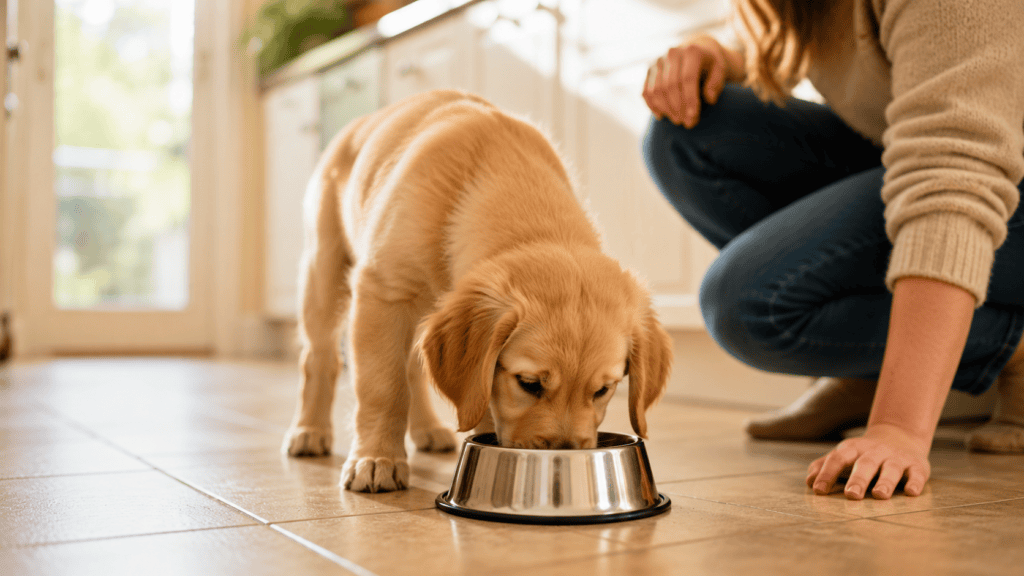
Puppy feeding is the one stage where getting it wrong has consequences you cannot undo later. Not because puppies are fragile - they are startlingly robust - but because you are feeding a skeleton while it is still being built, and bone does not get a second attempt.
How often to feed
A puppy’s stomach is small and its energy demand is enormous, so the ration gets split:
- Up to 12 weeks: four meals a day.
- 12 weeks to 6 months: three meals a day.
- 6 months onwards: twice daily, and that is the pattern for life.
The total matters more than the split, but at this age the split genuinely helps - large single meals in a small stomach cause exactly the loose stools that get blamed on the food.
How much to feed
Start with the feeding guide on the pack, matched to your puppy’s age and their expected adult weight rather than what they weigh now. Then adjust to what you can see and feel.
Manufacturers’ guides tend to be generous. That is not a conspiracy - they are written to cover the hungriest, most active dog of that weight - but it does mean the number on the bag is an upper bound for most puppies.
Our feeding calculator will give you a daily amount from your puppy’s weight and the food’s calorie density, which is more accurate than a generic chart because it uses the actual food you are feeding.
The large-breed problem, which most guides skip
This is the part worth reading twice.
Large and giant breeds grow for far longer, and their skeletons are carrying much more weight while they do it. Feeding them too much - or feeding them a standard puppy food too rich in calcium - makes them grow faster than their joints can cope with. That is associated with developmental orthopaedic problems including hip and elbow dysplasia and osteochondrosis. [1]
The instinct to get a big dog growing is exactly backwards. A large-breed puppy should grow steadily and unremarkably, and be kept lean throughout. A chunky Labrador puppy is not thriving; it is being set up for joint problems at seven.
When to switch to adult food
Growth plates close later in bigger dogs, so the switch is about size, not birthdays:
- Small breeds (under 10kg): 9-12 months
- Medium breeds (10-25kg): around 12 months
- Large breeds (25-45kg): 15-18 months
- Giant breeds (45kg+): 18-24 months
Switching early is a slow mistake rather than a dramatic one - the puppy simply stops getting the extra protein, fat and minerals while it is still building. Switching late mostly just means an over-rich diet and some weight gain, which is easier to correct.
When you do switch, do it over 7-10 days. Our guide to switching food has the exact ratios - a rushed change is the most common cause of the upset stomach that gets blamed on the new food.
What actually matters in a puppy food
Puppy foods do noticeably better than the catalogue as a whole on our scores - nearly half cleared 80 when we checked in August 2026. Puppy formulas tend to be built more carefully, because manufacturers know buyers are paying attention at this stage.
What to look for, in order:
- A named meat, high in the list, with a percentage. Same rule as any food. “Chicken 45%” is information.
- “Complete” for growth, not “complementary”. A complementary food is not a diet - it is a topping. The pack must say it is suitable for growth or for all life stages.
- Large-breed formulation if relevant. See above. This is the one that matters medically.
- Nothing vague. The usual suspects cost points for puppies exactly as they do for adults:
Meat and animal derivativesThe vaguest term on any UK label - it can mean almost any animal part from almost any species, and the recipe can change batch to batch.Cereals (unspecified)Which cereals?Artificial coloursDye for the human buying the food - your dog cannot see the pretty colours and did not ask for the additives behind them.
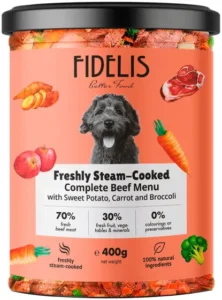
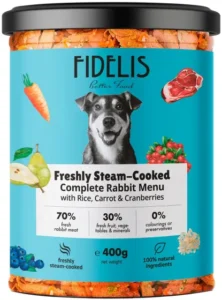
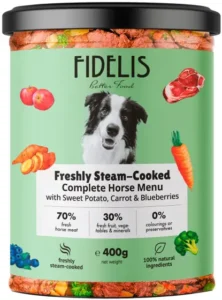
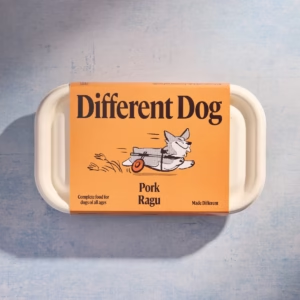
Our label guide covers the rest of the terminology. And this is what passes all four tests today - the current top of the puppy table, re-ranking itself as we rate more:
Wet, dry or raw for a puppy?
All three work. Dry is by far the biggest group among the puppy foods we rate, with a solid choice of wet, raw, fresh-cooked and cold-pressed alternatives.
Dry is the practical default - easy to measure accurately, which matters more at this stage than at any other. Wet is more palatable and useful for a puppy who is slow to eat. Raw puppy diets exist and some score extremely well, but they demand real handling discipline and a properly balanced complete recipe, not just meat and bone. Our raw feeding guide covers what that involves honestly.
What matters far more than format is that the food is complete for growth and that you feed the right amount of it.
Things that worry new owners but usually should not
- A missed meal. One skipped meal in an otherwise bright, playful puppy is rarely anything. Two, or a flat puppy, is a vet call.
- Eating grass. Extremely common and usually meaningless.
- Bolting food. Normal, if unnerving. A slow-feeder bowl fixes it.
- Soft stools after a change. Expected for a few days. Blood, or lasting more than about 48 hours, is not.
Where to go next
- The best puppy food - top 10, ranked
- Browse every puppy food we rate and filter by type, brand or price
- Work out your puppy’s daily amount from their weight and their food
How much should I feed my puppy?
Start with the feeding guide on the pack for your puppy's age and expected adult weight, then adjust by what you see. A growing puppy should have a visible waist and ribs you can feel easily under a thin layer. The pack is a starting point, not an instruction - most are written generously.
How often should I feed a puppy?
Four meals a day up to about 12 weeks, three from 12 weeks to around six months, then twice daily for life. Splitting the ration matters more than the total at this age: small stomachs cope badly with one large meal.
When should I switch my puppy to adult food?
Small breeds around 9 to 12 months, medium breeds around 12 months, and large or giant breeds 18 to 24 months. Growth plates close later in bigger dogs, so switching a Great Dane at a year is far too early.
Do large breed puppies need special food?
Yes, and this is the one genuinely important bit. Large-breed puppy foods control calcium and energy density to slow growth deliberately. Overfeeding a large-breed puppy, or feeding one a calcium-rich standard puppy food, is linked to permanent skeletal problems. Growing fast is not the same as growing well.
Can puppies eat adult dog food?
Not as a main diet while they are growing. Puppy formulas carry more protein, fat, calcium and phosphorus per calorie because a growing dog needs them. An occasional meal will not hurt, but adult food long term will not support proper growth.
Sources
- PDSA - Feeding your puppy
This is label analysis, not veterinary advice - if your dog has a health condition, talk to your vet before switching foods.